What Type of Art Style Is Used in the Adoration of Kings
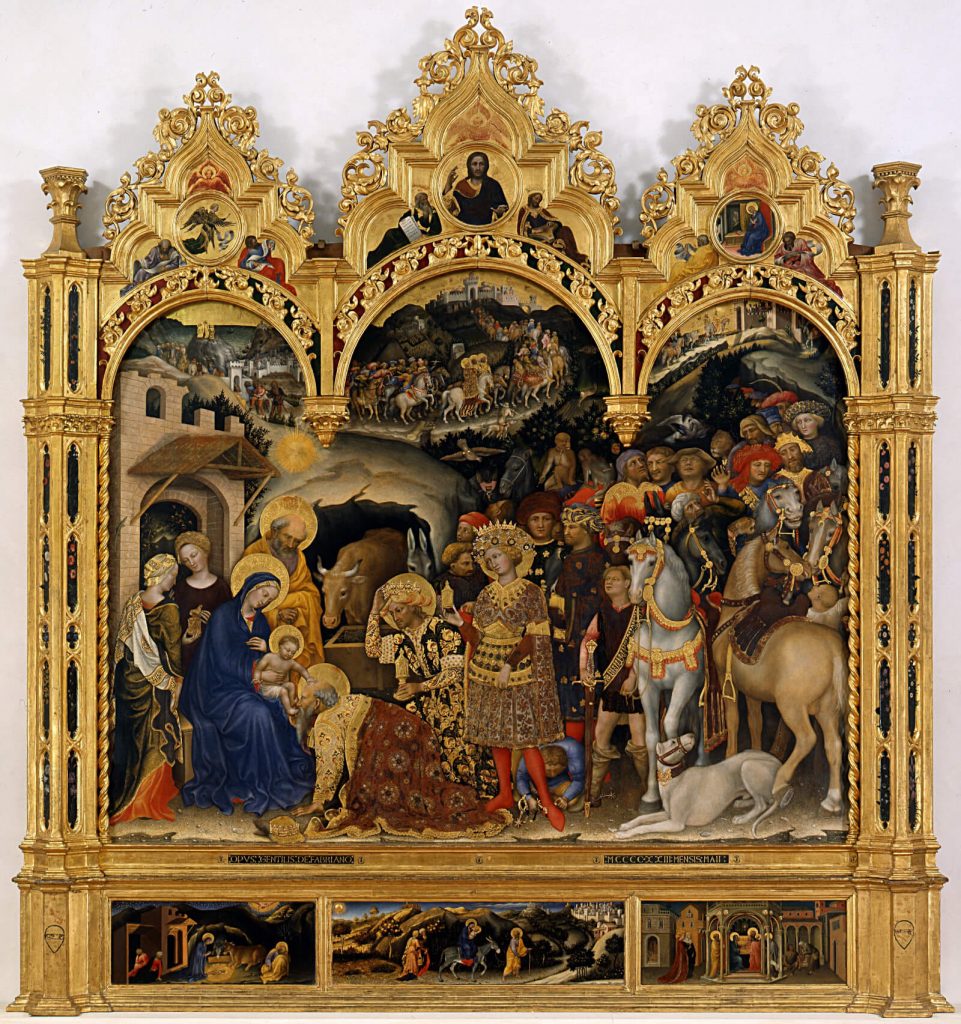
More than than two billion people in more than than 160 countries will celebrate Christmas this coming Friday. To mark this global Christian holiday, we explore a beautiful altarpiece which features scenes of not bad pomp and circumstance. Permit us venture into the brilliant world of the International Gothic. Let united states of america feel a 15th century Christmas with Gentile da Fabriano'south Admiration of the Magi.
Historical Context
International Gothic was the ascendant European artistic style of the late 14th and early 15th centuries. It appealed to the aloof taste in particular, every bit a result of its utilise of brilliant colours, lavish costumes, and intricate decoration. Adoration of the Magi gives u.s. a wonderful illustration of this. Undoubtedly it is the epitome of the International Gothic style. The piece of work is an altarpiece which has a very vibrant and gilt appearance. The creative person was Gentile da Fabriano. He painted the work in 1423 for the family chapel of his patron, Palla Strozzi – the Cappella Strozzi, which lies within the Basilica di Santa Trinità in Florence.
Gentile da Fabriano was a stylish leader of the International Gothic at this time. Similarly, Palla Strozzi was very stylish in his tastes. Moreover, as the richest banker and the wealthiest Florentine of his time he could afford to be. Look at the elegant shapes, the radiant colours, and the flowing lines throughout the work. Furthermore, its elaborate and gilded Gothic frame highlights the lavish taste that both artist and patron shared. In brusque, Adoration of the Magi is anything merely simple and understated.
The Proclamation
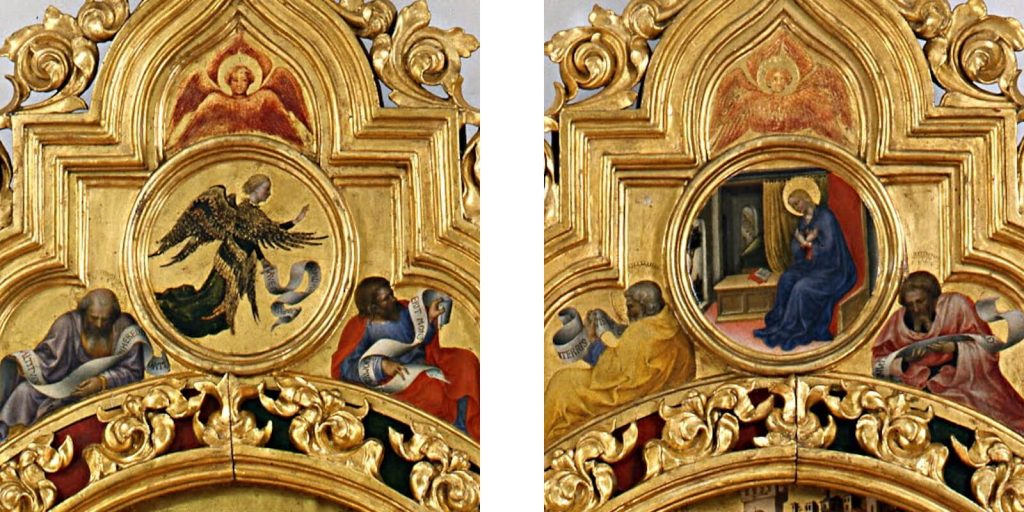
At the meridian of the work we find 3 spires. Each contains a tondo or round painting. In the central, largest tondo is an epitome of God. God is the supreme being in the Christian faith and rules over all the events happening beneath. In the left tondo we run across the Archangel Gabriel, facing to the right. He carries God's divine message in his hand, here shown in the class of a long written scroll. The message is that the Virgin Mary volition miraculously excogitate and get the mother of Jesus, son of God. In the far right tondo sits the Virgin Mary draped in blueish with her artillery crossed. She awaits the Archangel Gabriel bringing the divine message. The Announcement is about to brainstorm.
The Journey of the Magi
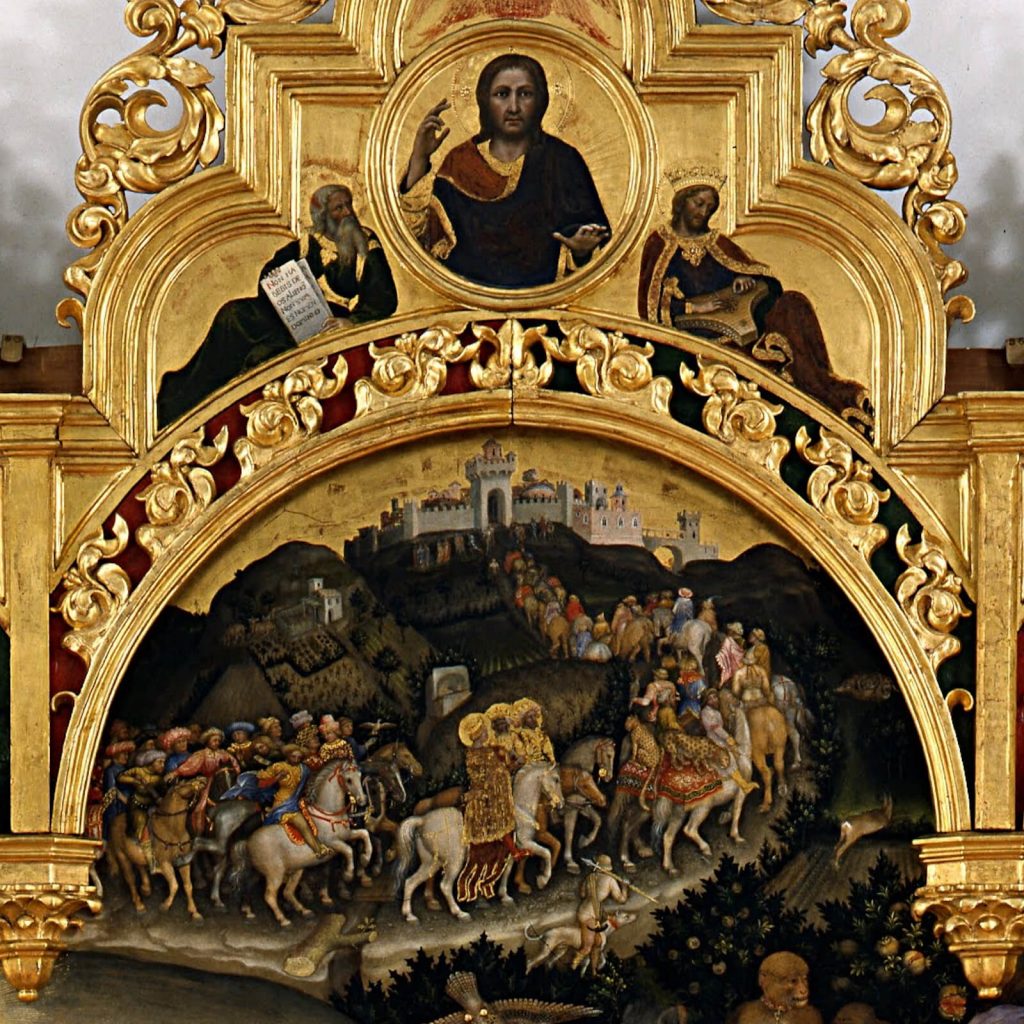
Beneath the 3 tondi are three semicircles of canvas framed in elaborate wooden molding. These 3 spaces depict the journey of the three kings or magi post-obit the Proclamation. The left semicircle shows the magi clad in gold, standing on a rock and observing the Star of Bethlehem. The fundamental semicircle shows them visiting Male monarch Herod'due south palace, escorted by a large entourage. The right and concluding semicircle sees them returning home. It is clear that the Adoration of the Magi does not represent one single moment. Instead, it depicts many moments spread over months and then combines them into the consummate narrative of the Christmas story.
The Adoration of the Magi
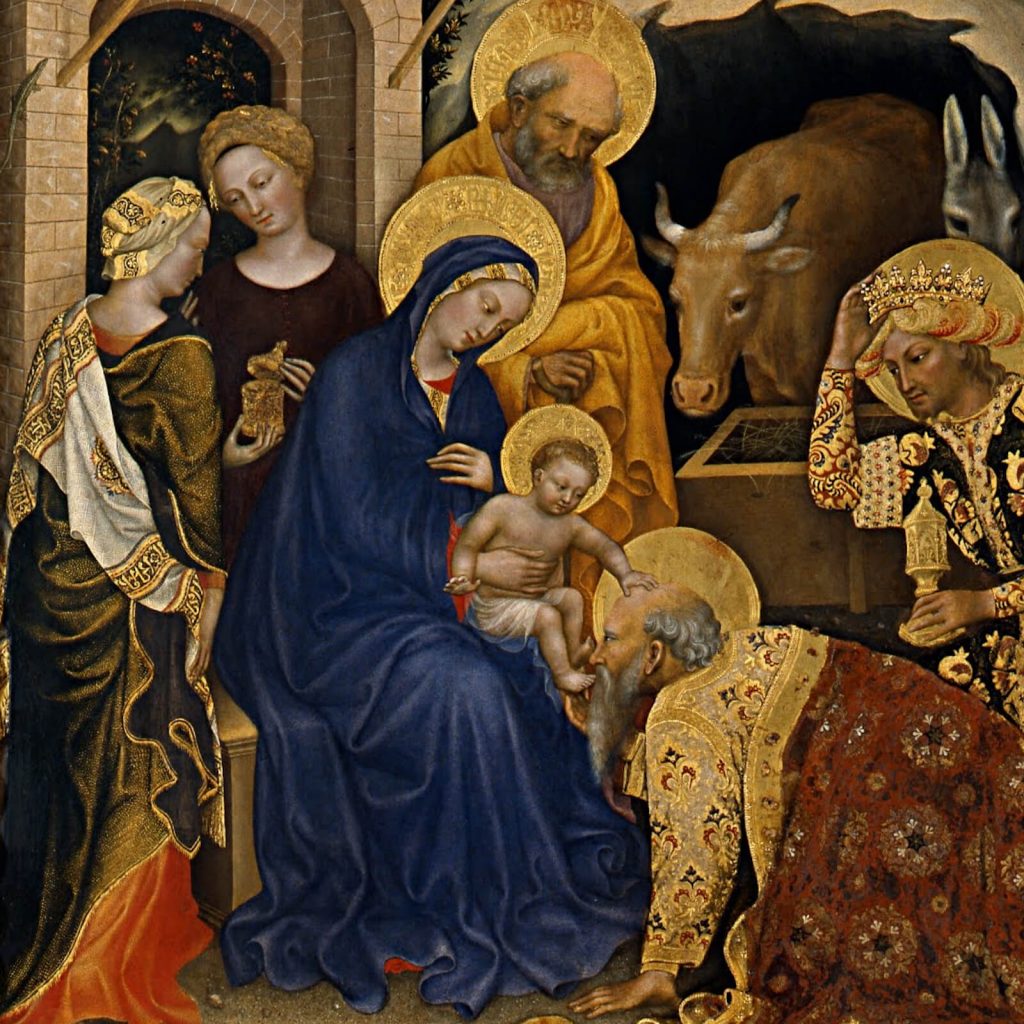
Beneath the spires, tondi, and semicircles is the dominant and most impressive scene of the altarpiece. Here nosotros see the namesake of the overall piece of work. The three magi nowadays their gifts of gold, frankincense, and myrrh. Gold represents the Son of God'due south sovereignty. Frankincense represents his divinity. Finally, myrrh represents his death.
Like their gifts, the three magi are shown as symbols of the three ages of mankind and stand for the earth. The king on the right is smooth-faced and immature. The central king has light facial hair and is heart-aged. The king on the left is bearded, baldheaded and elderly. Merely, signifcantly, they approach Jesus not as kings merely equally servants. They are bowing to the recognized ruler of heaven and globe. For this small, haloed child is the reason for this altarpiece. Baby Jesus sits in his mother'due south blue lap, simply clad in a white loin cloth. His stature is minor but his fashion is mature. He places his left hand on the old king's caput in a elementary act of benediction or blessing. The iii magi volition afterward go saints in the Christian organized religion.
Animals and people
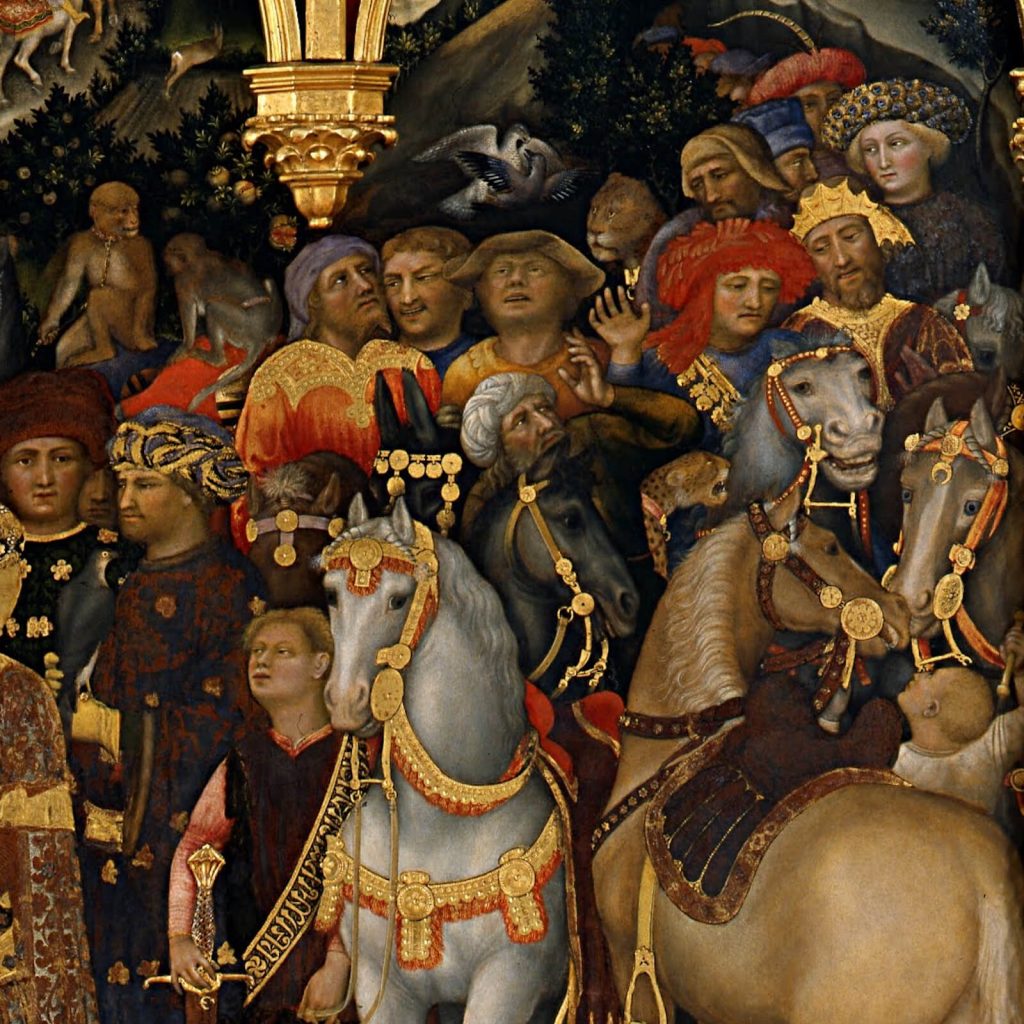
In addition to the three magi and the Holy Family, a huge crowd of followers and onlookers make full the correct half of the panel. Horses with gilt bits and reins stand up and prance in identify. Simultaneously, exotic animals like monkeys and cheetahs mingle with the crowd. Together, they form a first-class procession. This emphasizes the exotic origins of the three kings and their entourage. Moreover, they provide us with the full rainbow spectrum of colours. In that location are also highlights of embossed gilt leaf which nosotros encounter on the many spurs, halos, and sword hilts.
The overall composition of the work combines the splendour of Gothic detail with the realism of natural perspective. Some of the animals, like the horses in the foreground, are shown from varying angles. Others are foreshortened to give the illusion of depth. A homo on the ground near the youngest magi is foreshortened as he removes the aureate spurs from his chief's feet. These realistic features allude to the naturalism and linear perspective that will shortly dominate the after Italian Renaissance.
Inscriptions

Beneath the Admiration of the Magi is a thin dividing panel of wood inlaid with two black panels. They are inscribed in a capitalized Latin font. These gilt letters proudly proclaim "OPUS GENTILIS DE FABRIANO" and "MCCCCXXIII MENSIS MAII". This translates as "Piece of work by Gentile da Fabriano. 1423 Month of May." Clearly Gentile da Fabriano wanted everyone in perpetuity to know when Adoration of the Magi was created and by whom.
The Nascency
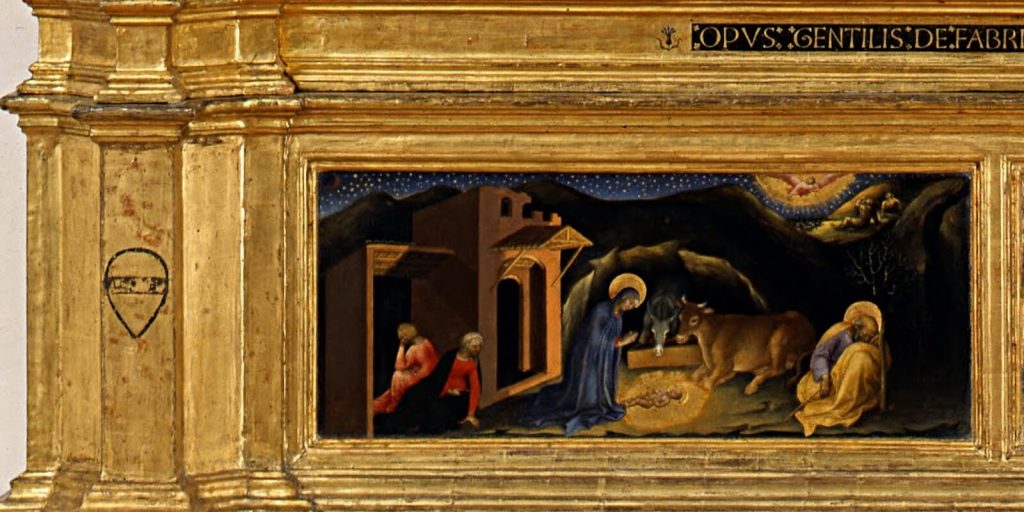
Beneath the inscription is the concluding and final panel of scenes known as the predella. A predella is a console below the main scene of an altar. Typically it volition contain smaller scenes related to the chief central image. In the predella of the Adoration of the Magi we see three miniatures. The left miniature depicts the Birth, the moment when Jesus is born in his apprehensive manger. This has taken place before the magi make it. Gentile da Fabriano'southward Nativity and so shows the Holy Family at dark. This is possibly the outset night fourth dimension Nativity in art history. The scene is illuminated by the glow coming from the Baby Jesus every bit he lays on the ground, adored by the praying and kneeling Virgin Mary.
The Flight into Egypt & the Presentation of Jesus
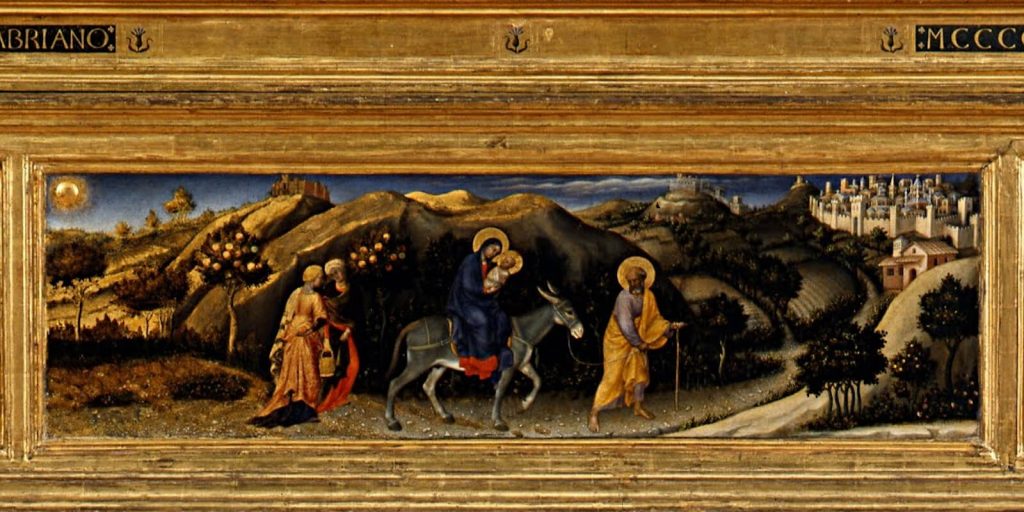
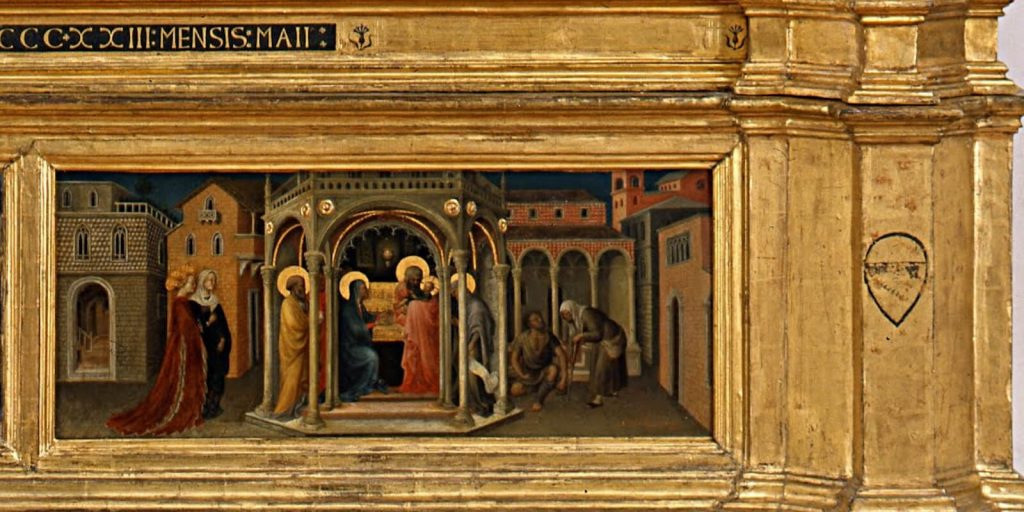
The centre predella paradigm shows the Holy Family's Flying into Arab republic of egypt. Mother and Child ride a donkey as Joseph leads his family unit to prophylactic. The right predella image is the Presentation of Jesus in the Temple. This marks Jesus' official induction into Judaism, forty days after his nascency. Interestingly, Gentile da Fabriano uses modern 15th century compages for the Biblical temple. Simply ironically, this "mod" scene is a 20th century re-create. The original 15th century panel is displayed separately in the Musée du Louvre, Paris.
Gentile da Fabriano painted the Adoration of the Magi in 1423. Do you think he would believe that society would value and appreciate his piece of work almost 600 years subsequently? For 597 years the work has beautifully shown us the scenes surrounding the early on Life of Christ and the story of Christmas. The Admiration of the Magi is not simply an International Gothic painting. It is an international Christmas painting too.
Works Referenced
- "Adoration of the Magi." Artworks. Galleria degli Uffizi. Accessed December 5, 2020.
- Charles, Victoria, Joseph Manca, Megan McShane, and Donald Wigal. 1000 Paintings of Genius. New York, NY: Barnes & Noble Books, 2006.
- Gardner, Helen, Fred S. Kleiner, and Christin J. Mamiya. Gardner's Art Through the Ages. twelfth ed. Belmont, CA: Thomson Wadsworth, 2005.
daughteryfireakingen43.blogspot.com
Source: https://www.dailyartmagazine.com/painting-of-the-week-gentile-da-fabriano-adoration-of-the-magi/
0 Response to "What Type of Art Style Is Used in the Adoration of Kings"
Postar um comentário